

This past Easter week, Chuuk was hit hard by Typhoon Sinlaku, which developed, intensified, and reached its peak on Saturday. Our Philadelphia School staff had just finished an Easter Break trip in the Chuuk Lagoon. Martin and Gedion joined a Faithwalk Christian College (FCC) outing to the Mortlock Islands, while other staff stayed on Weno, the capital island, to complete errands or rest before returning to Tol Island to prepare for the 4th school quarter at Philadelphia Christian School (PCS). As the storm grew into a typhoon, boat travel across the lagoon became impossible.
Unlike typical tropical storms in the Pacific that peak within 6–12 hours and then weaken, this system lingered over Chuuk for more than three days, steadily intensifying before becoming a full-blown typhoon and moving northeast toward Guam at only 5 km/h.
Videos from the dock on Weno show powerful waves and fierce winds battering the coast, destroying shops, homes, and a gas station at the main dock. Electricity on Weno has been out for an extended period, and cell phone networks across the island have been down, cutting people off from vital communication.
Our school principal, Sotto, and his family were stranded on Weno, enduring these power outages and having Wi‑Fi access only at Chuuk State Hospital. In contrast, on Tol Island, the Starlink satellite system at Philadelphia Christian School (PCS), supported by battery backup, continued to function. This reliable connection became a lifeline, enabling our team to stay in contact and keep partners informed as they faced the typhoon’s impact on the Faithwalk Christian College (FCC) and PCS campuses in the village of Chuukiyenú.

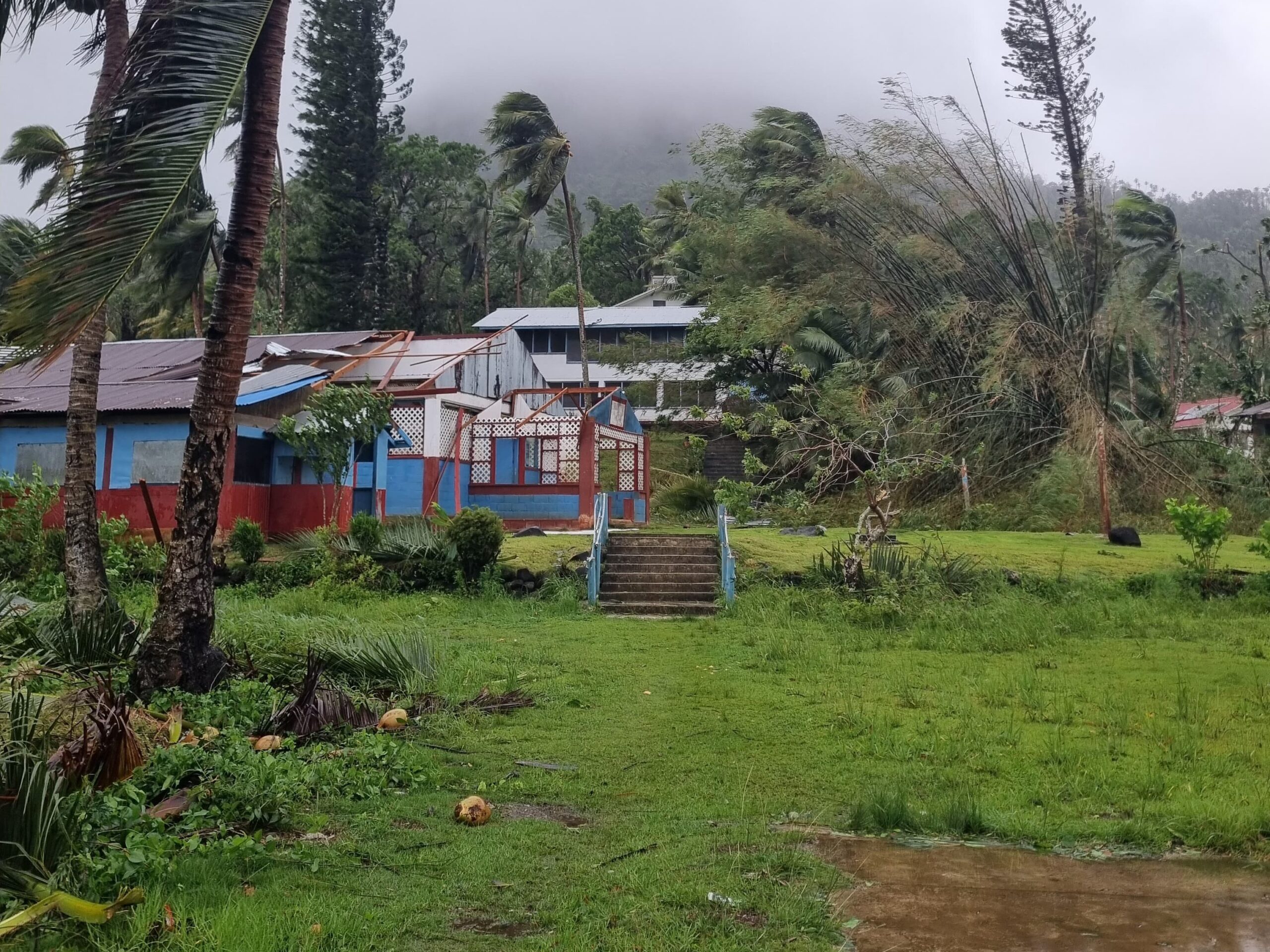
When the winds finally began to ease, our staff cautiously left the hilltop housing to assess the damage at the college campus and elementary school. At PCS, they found that the wind had torn off the tip of a tall tree, hurled it onto the school roof, where it smashed through the ceiling into the front room, cracking the cement wall.
Remarkably, the rest of the roofing withstood the gusts. Our RIC civil engineer and maintenance manager, Thony Magangat, conducted an initial inspection, documenting visible damage and identifying materials needed for urgent repairs. He estimated that roof repairs to the elementary school building alone will cost about 3,000 USD, based on pre-typhoon prices for building materials and labor, not including transportation across the lagoon.

As our team continued to document the damage, they showed how the roof of the local Philadelphia Village Church had been torn off on one side, with metal sheets flung into the mangroves. FCC staff and student housing on the hillside above the church, along with the boathouse at the dock, also suffered severe roof and structural damage, underscoring the typhoon’s lasting impact on the college community.
Several FCC staff members living in the nearby village lost parts of their homes and sought refuge in the college girls’ dorm, where the wind had also torn off part of the roof. Miraculously, no one was injured. The Bible translation houses, up to the newest hilltop accommodation, only suffered roof leaks and damaged rain gutters, even though breadfruit trees collapsed beside them and the wind destroyed a local hut, uprooting a mango tree, and damaging banana trees and tapioca plants in the house gardens.
Our RIC staff members living in Chuukiyenú village were also hit hard: the roof above two rooms in Sotto’s family home and about one-third of the roofing on CA and Andryn’s house—directly above where their grandchild normally sleeps—were blown away. Thankfully, the add-on room built to house the new teacher, Grace Lukania, employed by the DOE for Fosun Elementary School, remained intact.
We are thankful that the solar system funded by the Bosch Grant had not yet been installed when the storm hit. Around May 11, Jonathan Neumaier is scheduled to travel to Chuuk to install this system, which will provide a 14 kWh battery at both the school and the staff houses. For the first time in Chuukiyenú’s history, a Christian-run local school will have sustainable 24/7 electricity—enough to power a freezer, refrigerator, lights, computers, and a water pump.
Meanwhile, Typhoon Sinlaku has devastated small markets at the dock on the main island of Weno and many homes along the coastline, leaving numerous Chuuk residents homeless. The next support trips have been planned for May, July, and August. Your partnership can help bridge the gap between devastation and recovery— learning vocational skills by repairing roofs, restoring classrooms, and providing safe housing for families and staff.
If you, your church, or your youth group can help, we would deeply appreciate donations, hands-on construction support, and volunteers as vocational trainers. Thank you for your practical help, financial contributions, and faithful prayers for our team and the people of Chuuk.
Greetings from Elizabeth Rauchholz and our RIC team serving on site in Chuuk